
Islamic Geometric Art
For over a thousand years, Islamic geometric art has adorned mosques, palaces, and homes across the world. From the Alhambra in Spain to the shrines of Iran, from Moroccan courtyards to Indian monuments, these intricate patterns represent one of humanity’s most sophisticated artistic traditions.
Origins
Geometric patterns are one of the principle forms of Islamic art and ornament, alongside arabesque (Islimi) and calligraphy. Aniconism in Islamic art (the avoidance of depicting living beings) encouraged artists to instead explore mathematically derived forms of decoration, leading to the sophisticated patterns we see today.
Geometric patterns in Islamic art mainly involve straight-edge shapes that tesselate and repeat endlessly to create complex, multi-layer patterns. However, there are some examples of patterns with curved shapes, and patterns that don’t repeat but radiate from a central point.
Over many centuries, a common geometric vocabulary of shapes and patterns emerged across what is known as the “Islamic lands”, stretching from Spain and Morocco in the west to Iran and India in the east. One variation of the star/cross pattern (to the right), for example, can be found historically in Spain, Syria, Egypt, Iran, India and Pakistan.
Mathematically, these patterns can be grouped into families representing the number of lines of symmetry involved, which is why it is common to hear patterns described as “fourfold”, “fivefold” or “sixfold” (and less commonly, “ninefold” and “elevenfold”).


Regional styles
Alongside this universal vocabulary, several distinct regional styles developed, each with shapes rarely found outside the region, and different decorative approaches:
Spain (Al-Andalus)
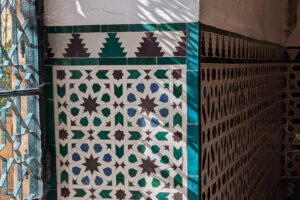
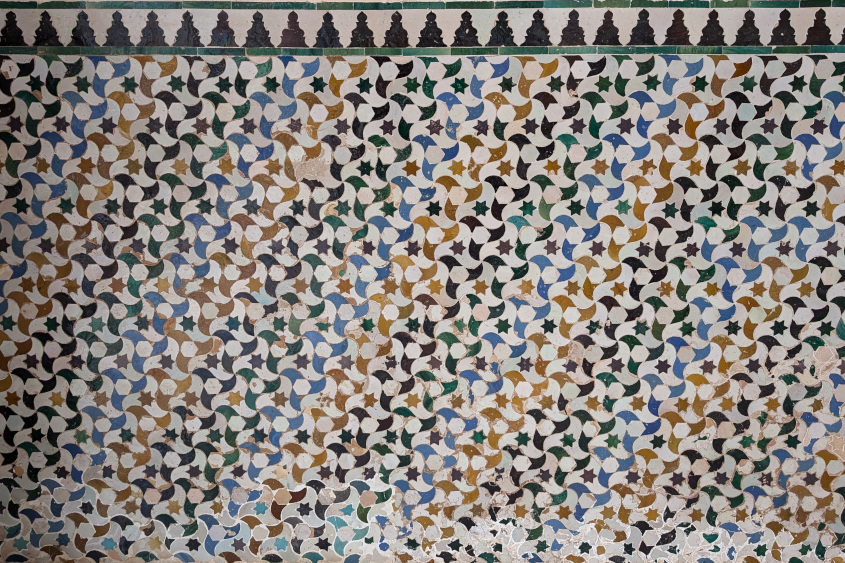
The term alicatado (from Arabic al-qata, “the cut”) describes the Spanish tradition of cut-tile mosaics. The Nasrid palaces of the Alhambra in Granada, dating from the 13th to the 15th century, represent a high point in the cultural expression of al-Andalus, featuring mosaics, plasterwork, and wood carving. The Alcazar in Seville is another stunning example of islamic design.
Morocco and North Africa
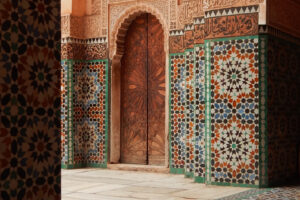
Zellige or zillij (from Arabic al zulaycha, meaning “little polished stone”) is a style of mosaic tilework made from individually hand-chiseled tile pieces, found in the architecture of Morocco, Algeria, Tunisia, and historic monuments of al-Andalus Wikipedia. The practice of making mosaics in this fashion has continued uninterrupted for over 1,000 years in Morocco.
The Al-Qarawiyyin Mosque in Fes, founded in 859 AD and significantly expanded in the 12th century, features some of the earliest examples of Zellige tilework in Morocco.
Persia and Central Asia
Persian traditions developed intricate “girih” tiles which involving strapwork. The edges of the tiles themselves would be hidden while the strapwork formed the visible shapes of the composition. This proved to be a much more effective method of creating complex 5-fold and 10-fold symmetries geometric compositions.

India
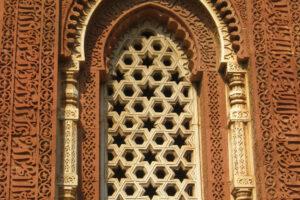
Mughal architecture combined Persian influences with local traditions, visible in monuments like the Taj Mahal, where jali (pierced stone screens) feature geometric patterns.
The craft
One of the most remarkable things about Islamic geometric patterns is that they were invented with the most basic of tools, before any precision measuring equipment existed. Using a ruler and compass, circles, then triangles, squares, hexagons and pentagons can be constructed, providing an underlying grid for a composition. Drawing further lines, craftsmen revealed a complex vocabulary of shapes from the intersections.
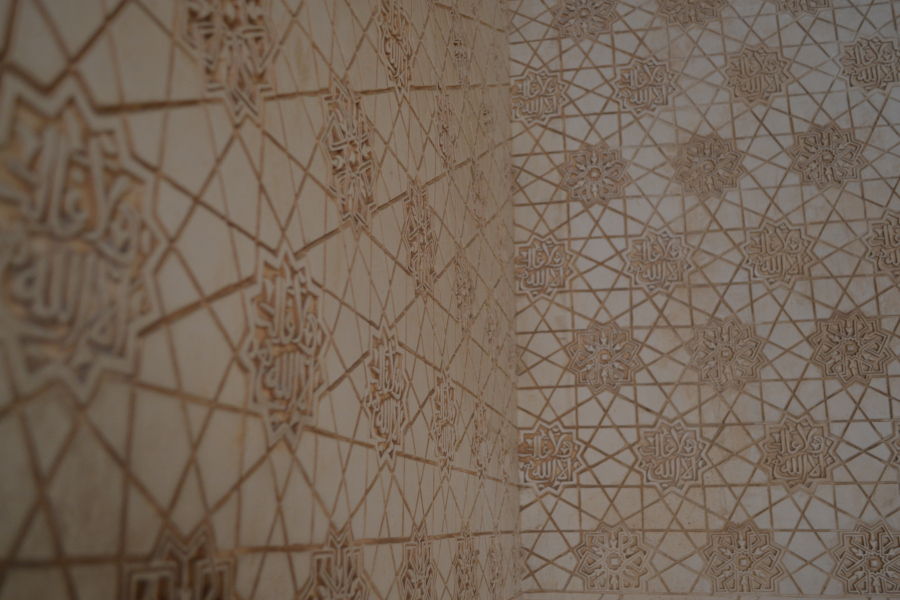
Once a pattern was drawn, it had to be rendered in some way. Islamic geometric patterns can be found in ceramic tilework, carved plasterwork, woodwork and marquetry, stonework and even metalwork. In some cases, geometric patterns have been applied to curved surfaces, such as the dome roofs of Syrian shrines or Egyptian funerary complexes.
The Alhambra
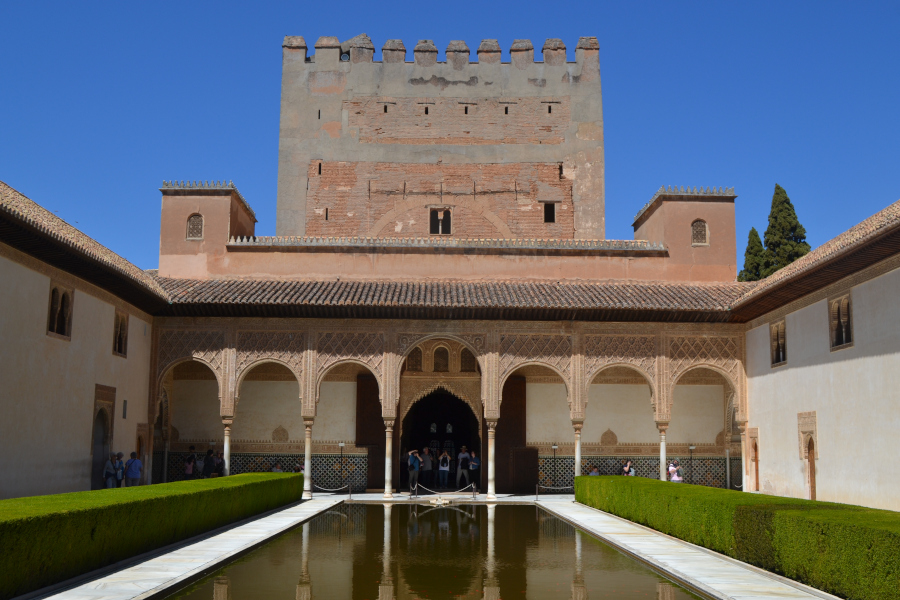
The Alhambra palace complex in Granada stands as one of the finest surviving example of Islamic geometric art in the world.
Built primarily during the 13th-15th centuries under the Nasrid dynasty, the Alhambra contains an extraordinary concentration of geometric patterns in tilework, carved plaster, and wood.
What makes the Alhambra particularly remarkable is that the palace features patterns from multiple symmetry families, showcasing both four-fold and six-fold designs. Some patterns feature shapes thought to have been invented at the palace itself.
The pajarita (“little bird”) pattern in the Court of the Myrtles was the first pattern that came to life at our studio, later forming the basis for one of our table designs. The Alhambra Mosaic Studio logo comes from a plasterwork carving in the Mexuar patio.

Resources for learning more
If you would like to learn about the history of Islamic geometric patterns, and how to draw them, we have put together a Resources & Links page. This page includes our recommended books, websites, and courses where you can take your interest further:
 English (UK)
  Español